Barrnon has successfully concluded the second phase of Innovate UK’s Small Business Research Initiative (SBRI) with an impressive demonstration of the Barrnon Integrated Decommissioning System (BIDS).
Under the auspices of the £8.5 million Integrated Innovation in Nuclear Decommissioning (IIND) competition organised by the Nuclear Decommissioning Authority (NDA), Phase 2 of the project culminated in a series of demonstrations that saw the system complete a wide range of tasks in a realistic simulation of a contaminated cell.
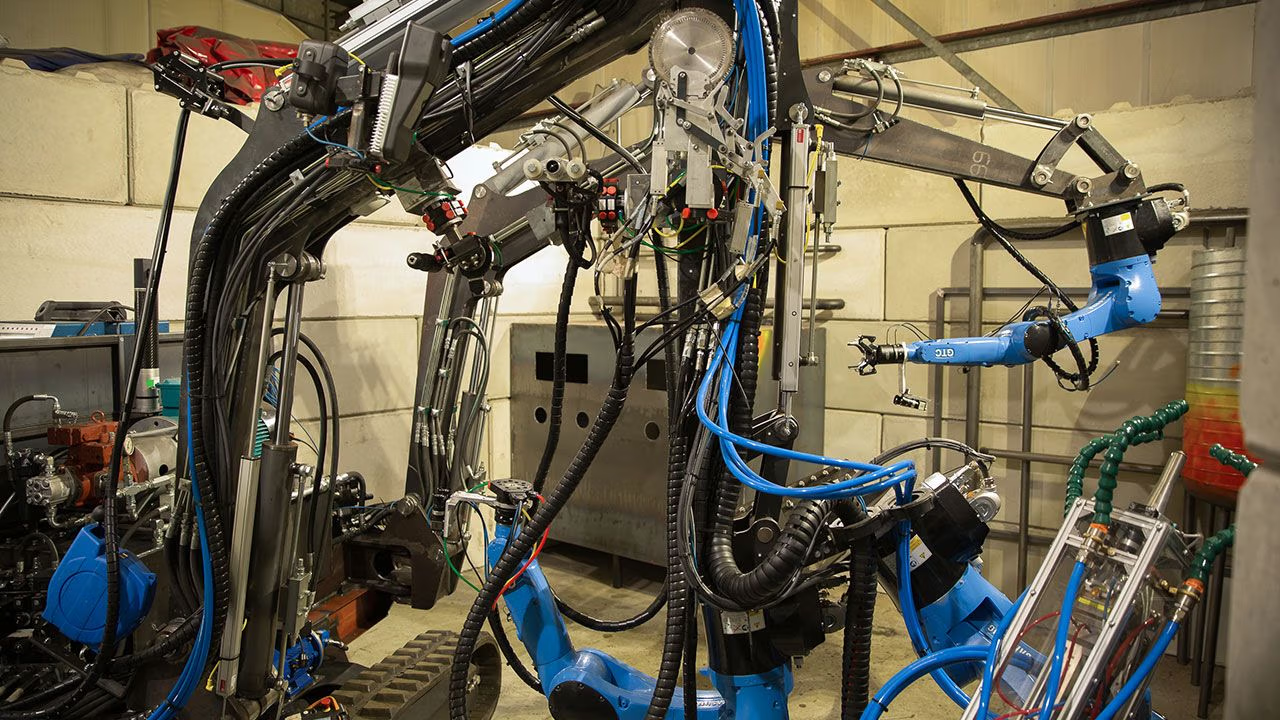
The revolutionary system developed by the Barrnon team alongside partners including Createc and Cambrian Intelligence comprises a tracked platform hosting hydraulically actuated arms, each with a robot at the end.
This allows BIDS to deploy a range of tools that are able to characterise and dismantle contaminated cell furniture, providing a fully integrated, end-to-end decommissioning process that can be used in hostile environments like the nuclear industry.
Controlled remotely, the system is driven into the target area before completing a 360 degree scan for radiation, building up a map of surface contamination inside the space.
Virtual reality
BIDS then uses advanced software algorithms to analyse the surface contamination data to plan dismantling operations taking into consideration safety requirements as well as the efficient segregation and packing of the waste.
A range of tools
The system’s tools can then be remotely deployed to decontaminate and dismantle infrastructure and the prototype system demonstrated the use of an array of tools and techniques including laser cutting, circular saw, stud welding, sludge removal and blasting with liquid nitrogen during the trials.
“We’re really delighted with the results of the recent trial,” said Managing Director, Andrew Barr. “It’s been a great team effort and we’ve demonstrated that robotic systems can play a vital role in reducing costs, timescales and operator risk in the nuclear decommissioning industry.”
Watch BIDS in action