
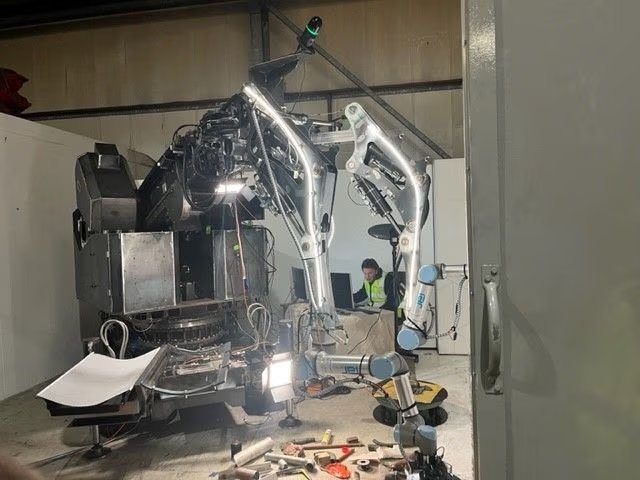
A robot. Unsupervised. Cleaning up nuclear waste…
Meet BLISSS – the latest Barrnon product ready for action.
More than 20 VIPs visited its Appleby site today (6th Dec 2022) — to see the company’s new sort and segregate machine working – and it received a hail of positive feedback.
Technical lead Philip Norman said: “This is a real time robot. It has no human involvement and we believe it will make a defining, real difference in the nuclear clean-up world.
“Waste of many types, produced by the nuclear industry, has been accumulating for decades. Worldwide.
“All this waste needs to be dealt with. The problem is, depending on what the waste is, what needs to be done can be very different.
“With the result that there are many different solutions each of which involves a whole industrial process in its own right.
“So the challenge is, someone has to go into what are quite hazardous places, in close proximity to potentially lethal objects, and sort through all this waste.
“To date, the best solution has been to send people in. Not anymore. We are delighted with how it’s worked out.”
BLISSS is an acronym for Barrnon Limited Sort & Segregate System.
It is an R&D project funded by Innovate UK. Barrnon is the lead contractor supported by a number of sub-contractors such as Innovative Physics Limited — who are providing specialised engineering services, almost entirely software related.
“Because people are exceptionally good at looking at objects, at deciding what they are, sorting them out into categories and physically handling these objects, then putting them in specially designated zones and/or putting them in specialised containers.
“On occasions, people are also called upon to cut up the bigger objects using appropriate tools. This is called size-reduction and it is absolutely necessary as very large objects are incompatible with the waste processing methods,” added Philip.
BLISSS is a robotic system that is vastly more powerful than a human being (it can pick up big objects and cut them into pieces and handle them with ease) yet with an extremely fine, sensitive touch, able to handle fragile and also very small objects.
A robotic system that has many of the perception capabilities of a human being yet also ones that human beings lack.
A robotic system that has a huge artificial brain, capable of emulating a human being but of going beyond that, consulting vast databases and considering far more possibilities, in real-time, than any human being could ever attempt.
A robotic system that can go in and do the work largely unsupervised.
It is highly mobile and has its own power supply which means it doesn’t need to be connected to a cable.
“And this makes it extremely capable,” said Philip. “It can reach over considerable distances and will be able to deploy a range of tools and sensors meaning that almost any task can be taken on and achieved. And because it is modular, as new technologies come along, the latest and best solutions can be added – software and hardware – and then be used to increase performance.”